
Finding the Best Bimini Repair Near Avalon
Why Avalon Bimini Top Service Matters for Serious Boat Owners
Avalon bimini top service covers everything from routine fabric care and hardware inspection to full replacement and professional reinstallation — and getting it right protects both your boat and your time on the water.
Quick answers for Avalon bimini top owners:
| Need | What to Do |
|---|---|
| Routine care | Clean monthly with mild soap and water; apply fabric guard |
| Trailering | Lower into travel brackets or tie down completely before transport |
| Fabric wear or fading | Evaluate for professional replacement using solution-dyed acrylic |
| Hardware failure | Source OEM or precision-matched components from a specialist |
| Mildew or UV damage | Dry thoroughly before covering; use breathable marine fabric |
Your bimini top is one of the hardest-working pieces of canvas on your boat. It takes direct sun, wind load, rain, and the mechanical stress of repeated folding and deployment. On Avalon pontoon boats specifically — where open deck layouts mean maximum UV exposure — a poorly maintained or ill-fitting top degrades fast. Fabric weakens. Frames misalign. Stitching fails at the seams. What started as a shade solution becomes a liability.
The good news: most bimini problems are preventable with the right service approach.
I'm Dan Jaques, founder of Yacht Canvas Pro, a Southern California marine canvas specialist with hands-on experience delivering precision-fitted bimini systems for vessel owners from San Diego to Newport Beach — including comprehensive Avalon bimini top service for pontoon and yacht owners who expect solutions that hold up season after season. Understanding the full lifecycle of a bimini top — from correct installation to fabric selection and end-of-life replacement — is what separates a system that lasts from one that fails prematurely.
Essential Avalon Bimini Top Service and Maintenance
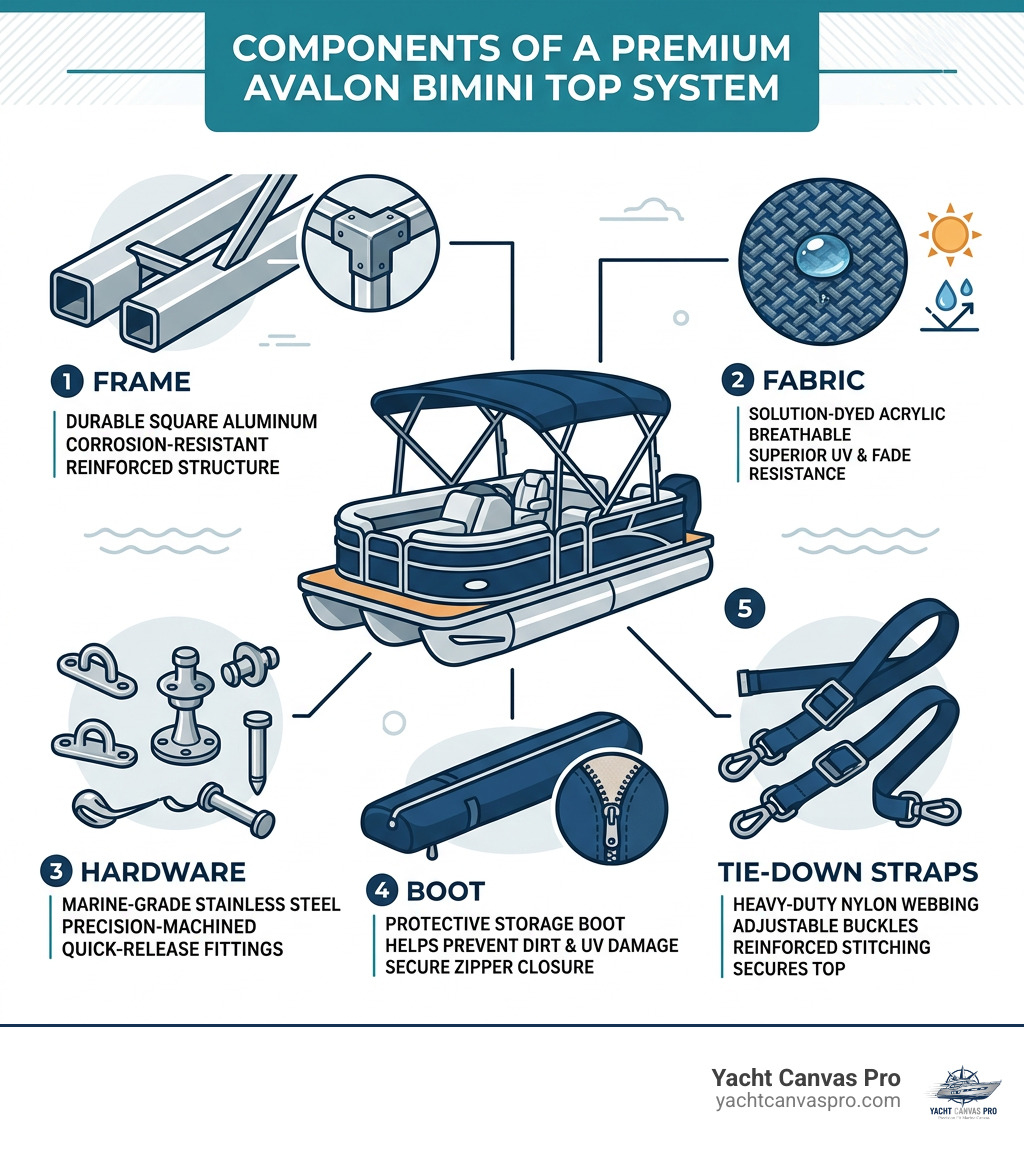
Maintaining a premium pontoon boat requires a shift in perspective: you are not just cleaning a piece of fabric; you are preserving a technical barrier against the Pacific elements. Avalon pontoons typically utilize high-performance materials like Navigator Marine Fabric or Sunbrella. These are solution-dyed acrylics, meaning the color is integrated into the fiber itself rather than printed on the surface. This is critical for the intense UV environment found in the Newport to Avalon corridor.
Professional Avalon bimini top service begins with a consistent cleaning regimen. We recommend a thorough cleaning at least once a month. Use a soft-bristle brush and a solution of mild soap and lukewarm water. Harsh detergents or pressure washers are the primary causes of premature fabric failure, as they strip away the fluorocarbon finish that provides water repellency.
When the fabric loses its ability to bead water, it stays damp longer, creating the ideal environment for mold and mildew. This is particularly problematic for boats moored in Avalon Harbor, where salt spray and high humidity are constant. After cleaning, the fabric must be allowed to air dry completely before being folded into its boot. Trapping moisture inside a storage boot is a guaranteed way to initiate "pink staining" and mildew growth on the underside of the canvas.
For those looking for a deeper understanding of these systems, our guide on Bimini Tops & Shade Systems provides a detailed breakdown of how different frame geometries and fabric choices affect the longevity of your shade system. Furthermore, following a standardized Bimini Care and Maintenance routine ensures that your warranty remains valid and your investment stays protected.
Proper Installation and Trailering Protocols for Pontoon Tops
A common point of failure for Avalon bimini tops occurs not on the water, but on the highway. High-speed wind resistance during trailering can exert hundreds of pounds of force on the bimini frame and mounting points. If the top is not properly secured, the aluminum tubing can buckle, or the mounting hardware can be ripped directly out of the rail.
According to the Avalon owner's manual, there are two safe configurations for transport:
- The Travel Position: This involves lowering the bimini top into the dedicated travel brackets. These brackets are designed to support the weight of the frame and prevent it from bouncing or vibrating at highway speeds.
- The Fully Stowed Position: If your model does not have travel brackets, the top should be placed completely down against the wall rail and secured with tie-down straps.

When we perform an Avalon bimini top service, we often see damage caused by owners who attempt to trailer their boat with the bimini in the "radar" or partially open position. This creates a massive sail area that the frame was never designed to withstand. Additionally, always ensure the storage boot is zipped tight and the "tail" of the zipper is tucked away to prevent it from flapping and damaging the fabric.
Securing Your Avalon Bimini Top Service Components
The hardware that holds your bimini in place is just as vital as the fabric itself. Avalon pontoons often use specific components such as 1/8-inch foam stanchion gaskets and black plastic or stainless steel side mounts. Over time, the vibrations from the engine and the water cause these fasteners to loosen.
During a professional service check, we inspect the following:
- Stanchion Gaskets: These prevent metal-on-metal contact and reduce vibration. If they are compressed or missing, the frame will rattle, eventually weakening the mounting holes.
- Side Mounts: We check for hairline cracks in plastic mounts and corrosion in stainless steel versions.
- Tie-down Straps: These should be under tension when the top is deployed. If the nylon webbing is frayed or the buckles are brittle from UV exposure, they must be replaced immediately to prevent the top from collapsing under wind load.
- Loose Items: Before transport, ensure that sundeck cushions, tables, and other loose accessories are removed or secured. A shifting table can easily tear a hole in a stowed bimini boot.
Protecting Your Investment from UV Damage and Mildew
In Southern California, UV radiation is the primary "silent killer" of marine interiors. A well-maintained bimini top acts as a shield for your upholstery. Without it, the vinyl on your Avalon—whether it’s a Catalina, Ambassador, or LSZ model—will begin to fade, crack, and lose its suppleness.
One of the most frustrating issues for pontoon owners is "pink staining." This is a byproduct of certain bacteria that grow inside the marine-grade foam of your cushions. When heat and moisture are trapped under a non-breathable cover, these bacteria thrive, leaving indelible pink marks on your vinyl. A breathable bimini top and mooring cover system are essential to mitigate this risk.
We specialize in Custom boat covers for Southern California that work in tandem with your bimini top to provide 360-degree protection. By using breathable fabrics like Sunbrella or Navigator, we ensure that moisture can escape while UV rays are blocked.
Professional Avalon Bimini Top Service for Fabric Longevity
To extend the lifespan of your canvas beyond the standard five-year expectation, we recommend the application of 303 High Tech Fabric Guard. This is the only product recommended by Sunbrella to restore the lost water and stain repellency of marine fabrics.
Our professional Avalon bimini top service includes a multi-step restoration process:
- Deep Extraction Cleaning: Removing embedded salt crystals and environmental pollutants.
- Antimicrobial Treatment: Applying a mold-inhibitor that is safe for solution-dyed acrylics.
- Hydrophobic Coating: Applying Fabric Guard in a controlled environment to ensure maximum bonding to the fibers.
This process ensures that your canvas remains a "dry" barrier. When water beads and rolls off, it takes surface dirt with it, significantly reducing the maintenance burden on the owner.
Identifying Common Bimini Issues and Repair Needs
Even with the best care, the marine environment eventually takes its toll. Recognizing the early warning signs of failure can save you the cost of a full frame and fabric replacement.
Common issues we address during Avalon bimini top service include:
- Thread Rot: Most standard threads fail long before the fabric does. If you see seams starting to pull apart or "hairy" thread, the structural integrity of the top is compromised. We use UV-stabilized PTFE thread (like Tenara) which is guaranteed to last the life of the fabric.
- Hardware Corrosion: In the saltwater environment of Newport Harbor, even "stainless" steel can pit and corrode. Aluminum frames can suffer from galvanic corrosion where they meet stainless fasteners.
- Frame Misalignment: If the bimini is difficult to open or close, the frame may be slightly bent or out of square. Forcing a misaligned frame is the fastest way to snap a mounting bracket.
- Fabric Thinning: Hold your canvas up to the sun. If you see "pinholes" or areas where the weave looks translucent, the UV inhibitors have broken down, and the fabric is prone to tearing.
When to Seek Expert Avalon Bimini Top Service
There is a significant difference between a "universal fit" replacement and a precision-engineered Avalon bimini top service. While online catalogs offer discounted tops for various models, they often lack the exact tolerances required for a rattle-free fit on an Avalon rail system.
Seeking professional help is necessary when:
- OEM Replacements are Required: For newer boats under warranty, using OEM-spec hardware and fabric is vital to maintaining your 5-year bow-to-stern coverage.
- Custom Fabrication is Needed: If you want to extend your shade footprint or add a "shade kit" to cover the bow or aft deck, a custom solution is the only way to ensure it integrates seamlessly with the existing lines of the boat.
- Warranty Validation: Avalon requires that warranty registration be submitted within 30 days of purchase and that maintenance follows specific guidelines. A professional service record helps prove that the boat was cared for according to manufacturer standards.
Frequently Asked Questions about Bimini Maintenance
How do I clean my Avalon bimini top without damaging the fabric?
The key is to avoid heat and harsh chemicals. Use a solution of 1/4 cup mild soap (like Dawn or Woolite) per gallon of lukewarm water. Use a soft brush, rinse thoroughly to remove all soap residue, and always air dry. Never put marine canvas in a dryer or use a pressure washer, as both will destroy the protective coatings and potentially tear the fabric.
What is the correct travel position for a bimini top while trailering?
The most secure position is folded down into the travel brackets provided by Avalon. If your boat does not have these, the top should be fully lowered, covered with its storage boot, and strapped firmly to the railing. Never trailer your boat with the bimini top in the open position, as the wind load can exceed the structural limits of the aluminum frame.
Does the Avalon warranty cover damage from high-speed transport?
Typically, warranties cover manufacturing defects in materials and workmanship. Damage caused by improper trailering—such as "sailing" the top while driving at highway speeds—is usually considered "user error" or "misuse" and may not be covered. This is why following the manual’s transport instructions is critical.
Conclusion
Owning an Avalon pontoon is about enjoying the coastal lifestyle of Newport and Avalon without compromise. Your bimini top is the primary component that makes that lifestyle comfortable, providing a sanctuary from the sun and protecting the high-end finishes of your vessel.
At Yacht Canvas Pro, we don't just sell covers; we provide precision-engineered solutions designed for the realities of the Southern California marine environment. From Newport Beach to the moorings of Avalon, we ensure your boat is protected with the highest level of craftsmanship. If your shade system is showing signs of wear, or if you want to upgrade to a system that offers better fit and longevity, we are here to help.
Request a precision-fit bimini top consultation today and let us help you protect the moments that matter most on the water.